Zura Support Platform
ZSP // Secure Operations Platform // Zura Group
"The ZSP mission is to give qualified operators access to the backend systems, compliance wrapper, contracting discipline, financial controls, strategic access, and operational playbooks required to move from capability to credibility."
The Gap ZSP Closes
Capable operators often fail to scale because they lack compliance infrastructure, quote-to-cash controls, contract discipline, finance pathways, and institutional credibility.
Emerging operators may have former military, intelligence, logistics, or government access — but they often lack the systems required to convert that access into lawful, bankable, and repeatable business.
Governments, institutional clients, and capital partners require audit-ready compliance, structured contracting, and financial controls before they will award or finance serious work.
The ZSP Solution
ZSP is a controlled backend architecture for qualified logistics, intelligence, infrastructure, extractives, and stability operators. It is designed for teams that already have capability, relationships, or access — but need the institutional structure required to operate legally, scale responsibly, and win and perform credible work.
ZSP is not a fixed menu of services. It is a platform of controlled backend capabilities that can be activated by contract, business development need, corporate setup requirement, project launch, financing requirement, or ZSP direction.
ZSP compresses years of backend development into a structured platform while preserving Zura control over risk, brand, compliance, and strategic access.
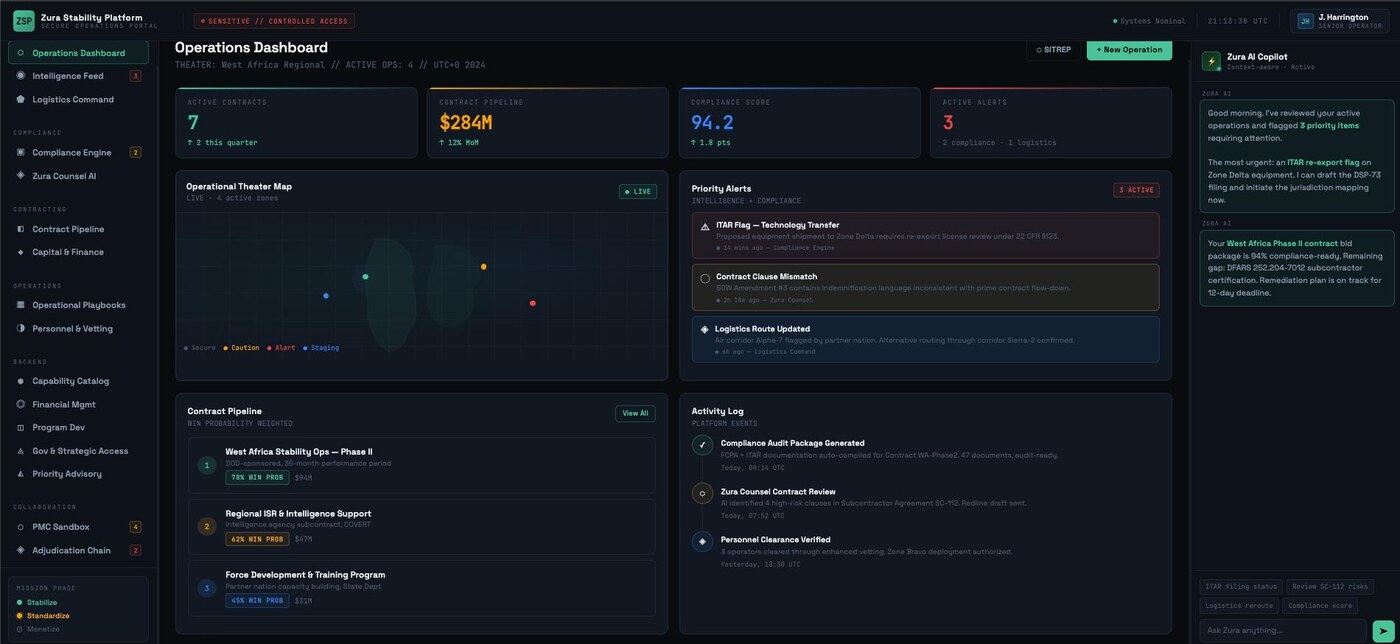
Operators access a unified command interface — real-time contract pipeline, compliance scoring, priority alerts, theater mapping, and Zura AI copilot — all in one controlled environment.
ZSP Operations Dashboard — West Africa Regional Theater // Active Ops: 4
What ZSP Provides
Regulatory review, risk classification, export-control screening (ITAR/EAR), anti-corruption controls (FCPA/AML/KYC), governance, and audit-ready procedures. Every engagement enters through a controlled compliance gate.
Operational systems, logistics, intelligence support, program development, capture support, and execution oversight. ZSP moves operators from informal activity to disciplined, measurable performance.
Quotes, invoices, receivables, payables, custodial accounts, comptroller support, revenue-share reconciliation, and distributions. All platform-related receivables flow through ZSP-controlled or ZSP-approved channels.
Platform Mechanics
Operator is reviewed, scoped, tiered, and integrated into the ZSP control environment. ZSP assesses operator background, geography, capabilities, deal flow, compliance posture, and strategic fit before assigning tier and catalog access.
Operator submits action queries tied to corporate setup, business development, capture, financing, logistics, compliance, or execution. Each tier includes a defined monthly action-query allowance.
ZSP determines which backend capability is activated, who controls it, what deliverable is produced, and what risk controls apply. Access depends on tier, engagement scope, risk, and ZSP discretion.
Quotes, contracts, invoices, receivables, payments, revenue share, and distributions flow through platform-approved financial channels. ZSP may require custodial accounts, escrow arrangements, or controlled disbursement processes.
Operators graduate to higher access levels as contract volume, compliance performance, and strategic value increase. Revenue, compliance track record, and ZSP discretion determine graduation timing.
Access Tiers
Access is tiered by scope, capability depth, and ZSP approval. Engagement terms are defined through the operator review process.
Scale
Thin compliance + contracting layer. Operators with existing infrastructure.
Growth
Modular access. Select capabilities across core and advanced platform sections.
Launch
Full platform access. For operators ready to deploy immediately.
Backend Capability Catalog
The catalog below is written as query lines because the platform is designed to operate through direct, action-oriented requests. Each query may result in a deliverable, review, coordination action, external engagement, internal approval, or ZSP-directed workstream. Access depends on tier, engagement scope, risk, contract requirements, and ZSP discretion.
A centralized compliance and governance backbone helping operators conduct lawful, defensible, and audit-ready activity across U.S., international, and host-nation environments.
Typical triggers: new country entry, foreign government engagement, defense-related scope, subcontractor onboarding, sensitive logistics, export-controlled equipment, politically exposed counterparties.
Design, implementation, and oversight of operating systems that move an operator from informal execution to disciplined, measurable performance.
Typical triggers: operator launch, new field office, new program award, operational failure risk, regional expansion, high-value contract pursuit.
Integrated logistics and intelligence functions that allow operators to plan, move, secure, and sustain activity in complex or non-permissive environments.
Typical triggers: sensitive cargo, personnel movement, aviation requirement, hostile or unstable jurisdiction, asset protection requirement.
Lawful, compliant, and structured force development programs where authorized by contract, jurisdiction, and applicable U.S. and host-nation law.
Typical triggers: host-nation training program, private security force development, special capability requirement, government contract pursuit, security reform project.
Programs developed from concept to executable structure across sovereign, commercial, infrastructure, security, intelligence, logistics, and stabilization initiatives.
Typical triggers: new program concept, sovereign request, large proposal, institutional partner discussion, infrastructure/security initiative, capital raise.
Opportunity assessment, capture, proposal, pricing, negotiation, and contract administration. Contracting is distinct from capital formation.
Typical triggers: active procurement, sole-source opportunity, foreign government proposal, teaming discussion, contract award.
Financing access, bankability, lender/investor readiness, project finance, receivables finance, trade finance, and capital-stack structuring.
Typical triggers: operator needs working capital, contract requires mobilization capital, project requires outside financing, receivables need monetized.
High-level engagement, relationship development, sovereign alignment, and strategic positioning. Access is controlled and never automatic.
Typical triggers: sovereign opportunity, ministerial meeting, international summit, embassy engagement, high-risk counterparty, geopolitical sensitivity.
Senior advisors, technical experts, or high-profile strategic figures activated based on opportunity, operator tier, engagement need, and ZSP approval. Seats are controlled by ZSP and assigned selectively.
Typical triggers: major proposal, sovereign engagement, investor diligence, credibility gap, technical requirement, board-level relationship need.
Full financial management backbone for operators, subsidiaries, SPVs, projects, or contract-specific entities. Governs how money is quoted, invoiced, received, controlled, paid, accounted for, and distributed.
Typical triggers: operator onboarding, project launch, new SPV formation, contract award, customer invoicing requirement, owner distribution event, audit request.
Who ZSP Is For
Real capability but missing compliance infrastructure, quote-to-cash controls, contract discipline, finance pathways, and institutional credibility required to win and perform serious work.
Strong in-country relationships, government access, or local networks — but needing a lawful, credible, and scalable backend structure to convert that access into bankable, repeatable business.
Operators in logistics, intelligence support, cyber, infrastructure, aviation, training, or security who need a larger platform around them to compete for and perform significant government or commercial work.
Teams pursuing government, sovereign, infrastructure, or complex commercial work where credibility and compliance are prerequisites — and where an established backend is a competitive requirement.
Getting Started
ZSP assesses operator background, geography, capabilities, deal flow, compliance posture, and strategic fit.
ZSP assigns a package tier, defines catalog access, confirms query allowance, and identifies any restricted sections.
ZSP establishes receivables process, financial controls, reporting cadence, data room standards, and authority matrix.
Operator begins submitting action queries. ZSP activates backend capabilities based on scope, risk, and strategic priority.
Operators graduate to higher access based on revenue, compliance performance, strategic value, and ZSP discretion.
Request Operator Review
ZSP accepts qualified operators through a controlled review process. Submissions are reviewed for background, geography, capability, deal flow, and strategic fit before tier assignment.
"The difference between operators who scale and operators who stall is usually not capability. It is structure."
Include in your inquiry: Operator background / Geography of operations / Current capability and deal flow / Compliance posture / Tier preference
Submissions are reviewed directly by ZSP leadership. contact@zuragroup.org
ZSP capabilities are controlled and are not automatically included in every package. Zura retains discretion over what capabilities are activated, when they are activated, who controls them, and what approvals apply. Nothing in this document should be interpreted as an offer to provide unauthorized military, paramilitary, mercenary, export-controlled, or foreign defense services. All activities remain subject to applicable U.S., international, and host-nation laws, including export-control, anti-corruption, sanctions, procurement, and licensing requirements. Confidential — for qualified operators and strategic partners only.